The World · Sounds of the Realm · Venues · The Wheatsheaf

10 styles · 24 venues · 11 bands and companies · 18 artists · 62 songs

Little Wendle, Oxfordshire · The road and the country

The Wheatsheaf: Arriving
Arriving
The Wheatsheaf: On a night
On a night

One inn, one keeper: sixpence for a place in the shared bed and eightpence for supper, the same to the carrier of ten years as to a stranger. Ambrose Quirke plays here when he is not at a church door, and the village sings.

Music heard here: The Alehouse and the Green

The house

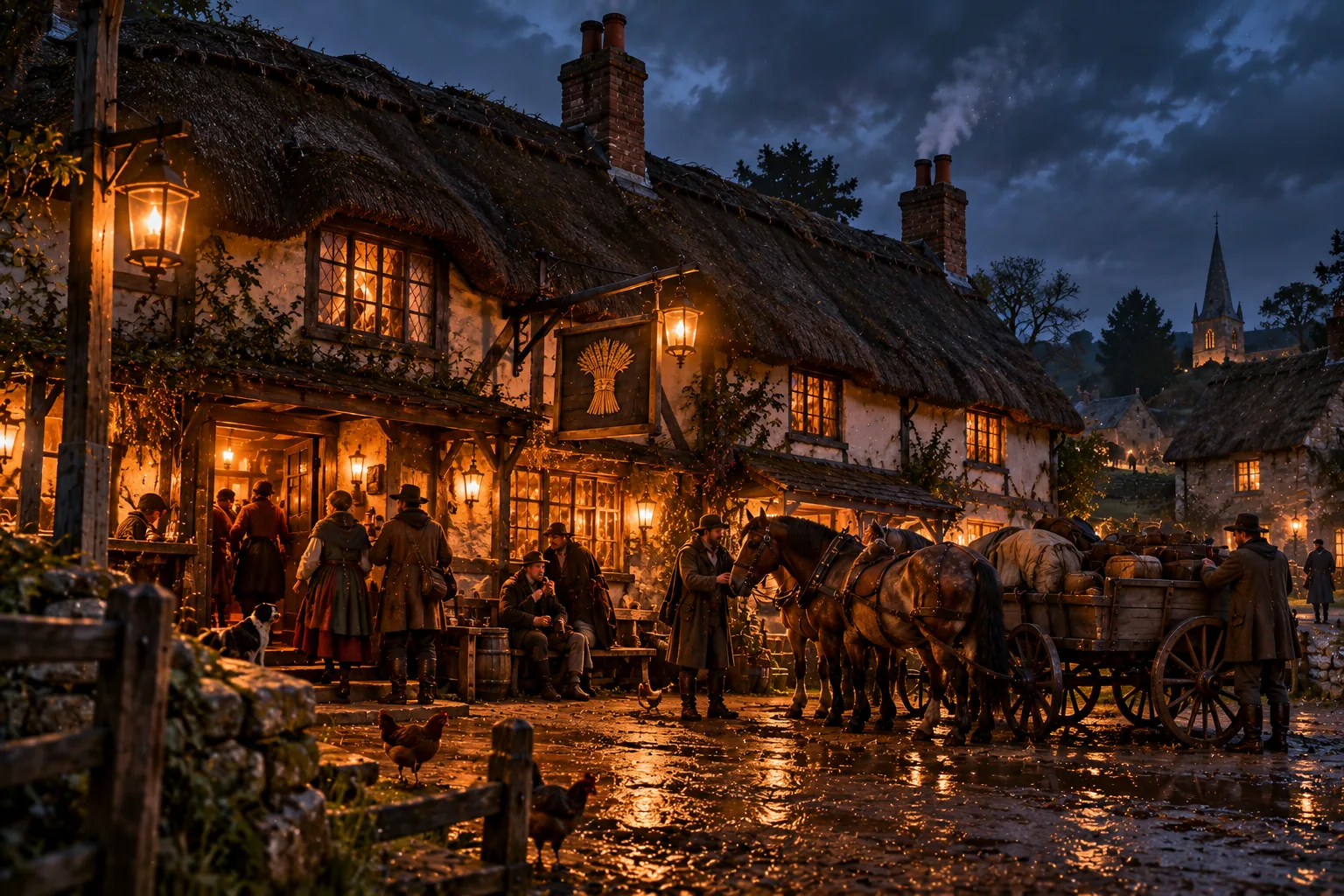
Little Wendle, Oxfordshire, a small village on the Wold carriers' round: the only inn, low and thatched, with a carved wheat-sheaf over the hearth.

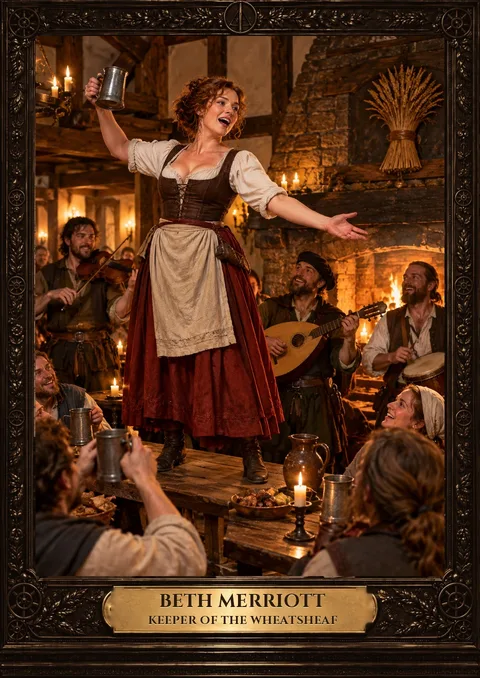
Beth Merriott, who has kept it since her mother died; sixpence for a place in the shared bed and eightpence for supper, the same to the carrier of ten years as to a stranger.

A night there

The village, Reeve Agnes Hartop, Jem Furlong the Thursday carrier, and Ambrose Quirke when he is not at a church door. Strangers are told what the village thinks they should know.

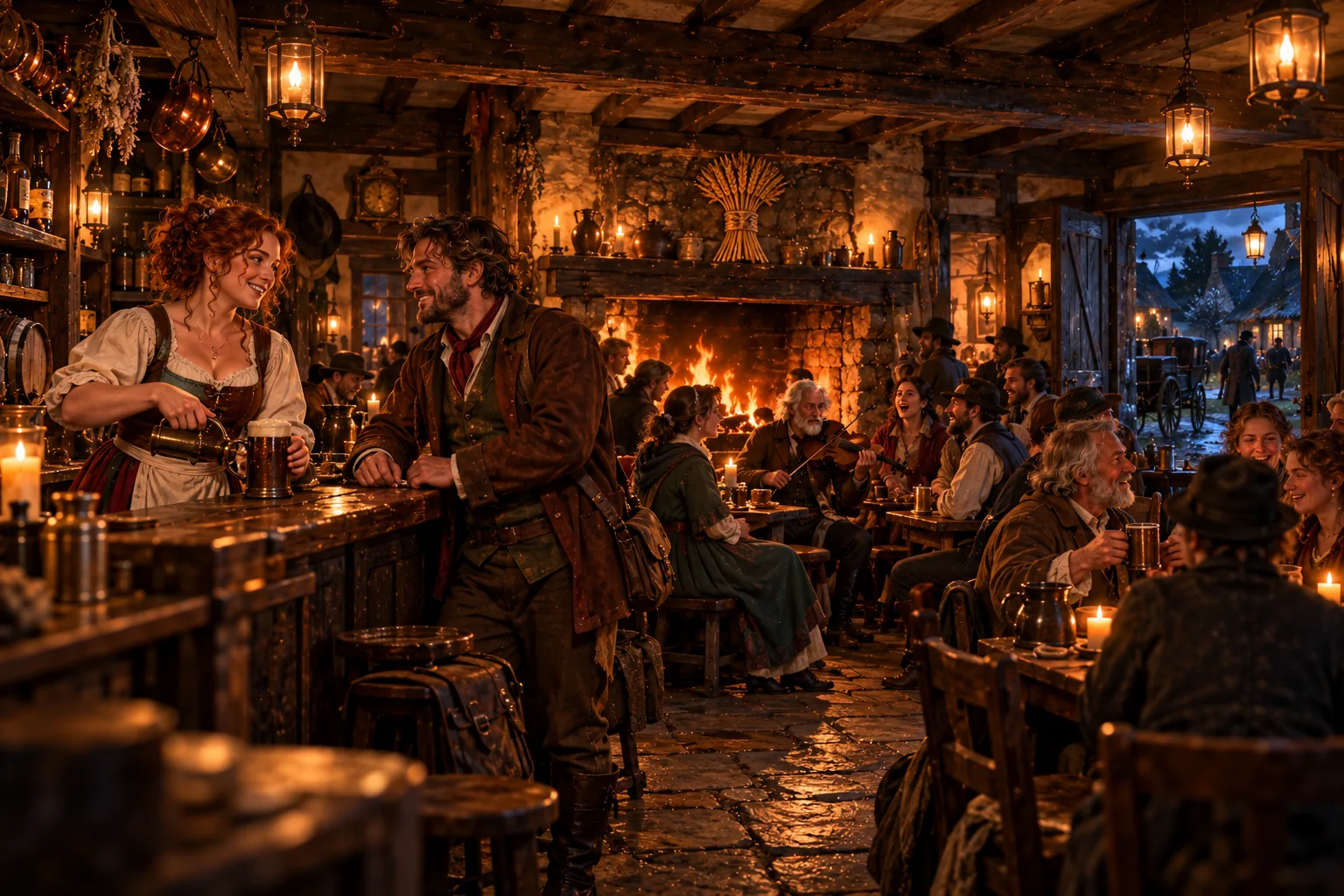
Fair nights and harvest nights, when Beth climbs on the long table with a tankard and the room comes in on the chorus; Midsummer, when the village walks to the green.

From its past

The parish book of Reeve William Cheverell, in 4389, records the old inn burned to its walls one harvest night. The carved wheat-sheaf over the hearth is the one thing saved from it, carried out by the keeper's daughter, and every keeper since has been a woman of that family.

Who plays here

The Quirkes of the Wold play here.

Portrait of Beth Merriott

Beth Merriott

Keeper of the Wheatsheaf

▶ Play all1 on YouTube · choose a title to play it
  1. Sixpence at the Wheatsheaf3:58
    Lyrics

    He comes in every Thursday when the carrier's road is done,
    With the mud of twenty parishes and the last of the setting sun;
    He takes his place upon the bench, his hat upon the nail,
    And I draw his pint before he asks, and he never calls it stale.

    It's sixpence for the shared bed, and eightpence for the plate,
    The same for him as any stranger walking through the gate;
    But the stranger gets the reckoning, and the carrier gets the rest —
    Every word in Little Wendle, and the one I've kept the best.

    Ten years he's come on Thursdays, through the snow and through the hay,
    Ten years I've charged him sixpence and he's never asked to stay
    One night more than the carrier's road will let a carrier keep,
    And ten years I've watched his lantern down the lane before I sleep.

    It's sixpence for the shared bed, and eightpence for the plate,
    The same for him as any stranger walking through the gate;
    But the stranger gets the reckoning, and the carrier gets the rest —
    Every word in Little Wendle, and the one I've kept the best.

    The reeve says I could charge him less, the village thinks it queer
    That a man who's paid ten years should pay the stranger's price this year;
    But I'll not take a farthing off, and I'll not tell them why —
    For if I charged him less, he'd know, and so, Lord help me, would I.

    So come in, carrier, off the road, the fire is banked and low;
    There's a word I've kept ten years for you, and tonight I'll let it go.

    It's sixpence for the shared bed, and eightpence for the plate,
    The same for any stranger walking in through the gate;
    But I'll take no coin from you tonight, so put your purse away —
    For a husband pays no reckoning, if you'll only ask to stay.
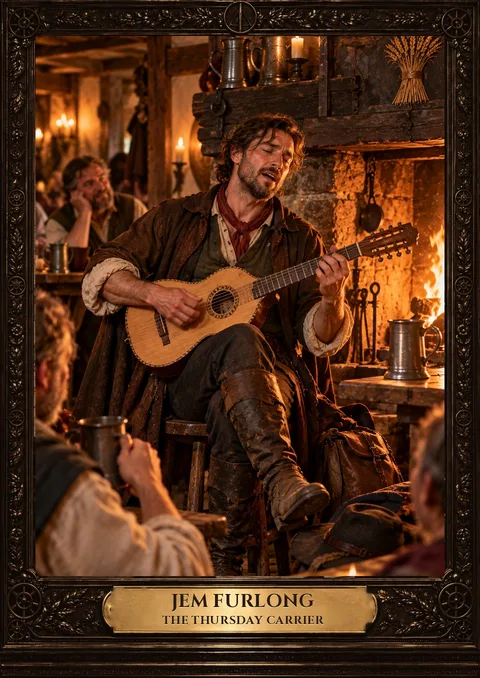
Portrait of Jem Furlong

Jem Furlong

The Thursday Carrier

▶ Play all2 on YouTube · choose a title to play it
  1. The Bridegate Manof General Roderic Hale, James Bell of Mereford3:22
    Lyrics

    When London lay in ruin and the ash was on the tide,
    And the old quarters held such things as no man named inside,
    They raised a redoubt at Bridegate where the crossing met the stone,
    And they gave the keeping of it to General Hale alone.

    Name it, walk it, then fire it — that was the Bridegate way;
    Never burn a quarter till you've walked it in the day;
    So here's to Roderic Hale, boys, who held the crossing then,
    And when you call a man a Bridegate man, you call him the best of men!

    In the Ash Scouring, forty-one, when they fired the broken town,
    He'd not let a street be lit until he'd walked it up and down;
    He went in first where the dead lay thick and the wrong things kept their hold,
    And he named every lane by its rightful name before the fire was told.

    Name it, walk it, then fire it — that was the Bridegate way;
    Never burn a quarter till you've walked it in the day;
    So here's to Roderic Hale, boys, who held the crossing then,
    And when you call a man a Bridegate man, you call him the best of men!

    Now his statue stands at the Lower Steps with its back to the London street,
    Looking down upon the river where the barges and watermen meet;
    And they say he's the only general in London who looks at the right thing —
    So raise your pots to the river, boys, and let the old man sing!

    And when they hanged James Bell beneath him for holding the crossing too,
    The watermen say the old stone wept — and I say that's likely true.

    Name it, walk it, then fire it — that was the Bridegate way;
    Never burn a quarter till you've walked it in the day;
    So here's to Roderic Hale, boys, who held the crossing then,
    And when you call a man a Bridegate man, you call him the best of men!

  2. The Greyfen Countermarchof Lord Gerold Greyfen of Lantern Fort1:31
    Lyrics

    When war was in the counties and the Crown was short of hay,
    It sent its schedule-men abroad to take the stores away;
    They came to Lantern Fort one morning, carts drawn up in line,
    And read Lord Greyfen out the price for hay and corn and kine.

    "Your schedule sets my hay at what my grandfather was paid;
    Then Grandfather can sell it you, and keep the price he made!"
    Then hey for Greyfen's Countermarch, and round behind we go —
    The carts go empty home again, the barns stay full, heigh-ho!

    The schedule-men went off for troops; the troops came up the road
    To take the hay at schedule price and carry off the load;
    But Greyfen did not wait for them behind his gate to fight —
    He marched out by the old approach and came round in the night.

    The soldiers at the gate stood fast with long pikes high and set;
    They heard the drums behind them, and they've not stopped running yet.
    The carts went home with nothing on, the barns at Lantern high,
    And four whole counties drank his health and drank the taproom dry!

    They say the Crown came back next spring with silver in a sack,
    And paid the market price for hay, and asked for nothing back;
    Now whether that is truth or pride, my lads, I do not know —
    But ask a Greyfen at the fort, and he'll not tell you no!

← All the venues
