Wood and orchard · Feral ground · The Northern Marches
Wychwood
Wychwood fills the western third of the Northern March and is the largest continuous stand of trees in the realm's north, chiefly oak, with hazel coppice in the south-east. A survey credits it with eleven thousand acres, though only seven thousand were actually walked. Its court, the woodmote, meets in the open air each quarter and hears disputes over cutting, pannage, charcoal and timber theft. Rides, burners' hearths and uncut belts all belong to it.
- Within
- The Northern Marches
- Holds
- 12 places, 11 directly
- Named in
- Book VI
History and lore
Wychwood fills the western third of the Northern March and is the greatest unbroken stretch of trees anywhere in the realm's north. Oak covers most of it, with ash and thorn at the margins, alder down by the water and hazel coppiced in the south-east. The most recent survey credits it with eleven thousand acres, though its men walked only seven thousand and copied the rest off an older map. In the march the name covers more than timber: the rides, the court, the yearly walking of the bounds, the burners' hearths and the eleven belts where nothing is ever cut.
The southern half is worked hard. Coppice comes down on a seven-year turn, charcoal hearths follow the cutting, the edge parishes send their swine in for ten weeks of mast from Michaelmas, and good oak goes to Harrowgate and by water to the coast for the shipyards. Two parts in three of what standing oak fetches go to the priory, whose richest income it is. Nine intermarried burning families live beside their hearths for eight months of the year, earn more than anyone else in the wood, and are the only people in it after dark. Every hearth has its bell, and every burner's hut has iron at its corners.
The wood answers to its woodmote, which sits four times a year in the open air beneath the Lord Oak at a crossing of rides. Four verderers hold office for life, regarders from the edge parishes spend three weeks walking the wood before Michaelmas and report aloud, woodwards keep their walks and agisters count the swine; only the decision is written down. The court can take away a man's right to cut, burn or graze, and there is no appeal, for the assize has never claimed the wood and the Crown has twice declined to make it a royal forest sooner than pay for its walking. The wood has an older fame too, for the great man-eater was hunted here between 4417 and 4419, and those hunts made Saint Hester's Hounds famous.
The northern quarter is another country. It has not been cut, walked or surveyed in living memory, and everyone in the wood holds a different opinion of what lives there. A traveller is told the same things by everyone: keep to the rides, pay what the burners ask, give the agister his coin at the gate, take nothing from the belts, and eat whatever bread the families of the middle ground offer. Since the priory had the whole wood valued, belts and all, the carriers' tables have talked of it paying for its building in standing oak, and Wychwood is uneasy.
Where the volumes speak of it
- Book VI › 21.2 Pannage
- Book VI › 21.3 Timber, and What It Pays For
- Book VI › 21.4 The Theft That Is Never Called Theft
- Book VI › 21.6 Working in the Wood
- Book VI › 1.3 The Three Districts, and What Each Is Like
- Book VI › 1.7 The Places a Traveller Actually Needs to Know
- Book VI › 19.1 Wychwood
- Book VI › 19.2 The Woodmote
Powers seated here
In the Chronicle
Met here
Faces found here


Within Wychwood
 Church and shrine · FringeThe Cell in the ClearingA small religious cell in a glade deep in the old oak of Wychwood, where the kept rides give out and the wood beyond is walked by no officer. It is one of the monastic…Wood and orchard · Feral ground · 1 withinThe Chapel BeltThe Chapel Belt is one of the eleven no-cut belts of Wychwood. A ruin stands in it which nobody now says was ever a chapel, and a stone there bears a cut cross, the best…Road and way · Feral groundThe Dead Rides of WychwoodTwo of Wychwood's nine hauling rides are still on the rolls but have not been cut for three generations; they run out of the worked wood into the middle ground and…Works and stores · FringeThe Last HearthThe last charcoal burner's camp before Wychwood's unworked middle ground: the point past which nobody will guide a party, where a company leaves someone to wait and keep…
 MonumentThe Lord OakThe Lord Oak stands at a crossing of rides in Wychwood. The Wychwood woodmote sits beneath it four times a year, including at the Michaelmas quarter, and its members say…Wood and orchard · FringeThe Middle Ground of WychwoodThe belt of wood between the worked south and the unwalked north, where families in nobody's book live on windfall and deadwood, bracken, mushrooms, nuts and the swine's…Wood and orchardThe North WoodThe North Wood is the northern part of Wychwood, distinct from the worked wood. Burners warn that it is not the same as the wood, and Harrowgate has nobody who has been…Wood and orchard · Feral groundThe Spring BeltThe Spring Belt is one of the eleven no-cut belts of Wychwood, where no timber may be felled. Its name, like that of Stream Head, is a plain one.
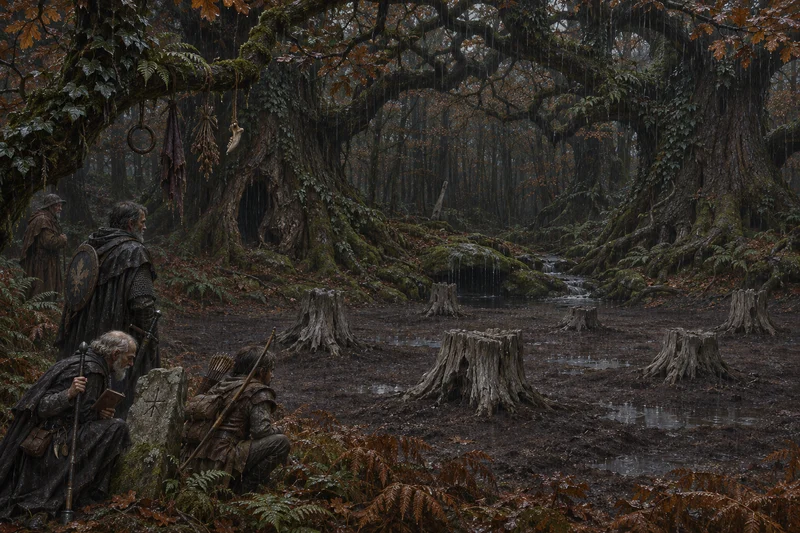 Wood and orchard · Feral groundStream HeadStream Head is one of the eleven no-cut belts of Wychwood, and also the name of a place with a vestry and a churchwarden. The rolls hold only one instance of a felling…Haunted ground · Feral groundThe Two Named BeltsTwo of Wychwood's no-cut belts are named for what is said to live in them, but the books deliberately withhold both names: burners will speak only the first word and…Wood and orchard · Feral groundThe Unmarked BeltThe largest of Wychwood's eleven no-cut belts lies on flat ground in the heart of the wood's finest oak and shows nothing at all; no timber, underwood, bark or bracken…

