Region · Fringe · Kent and the Narrow Sea
The Weald
The Weald is the clay country of Kent lying south of the chalk, a land of deep lanes, scattered farms and coppice cut for poles. It is very thinly peopled and so quiet that visitors from the northern parishes find it oppressive. Its lanes cannot bear a loaded cart between the first frost and the end of March, and the poorer ones are left unmaintained for the winter. Buildings are weatherboard and tile-hung, and the Weald once supplied much of the realm's iron. Greater lordship in its west belongs to House Ashcombe.
- Within
- Kent and the Narrow Sea
- Holds
- 10 places, 9 directly
- Named in
- Book V
History and lore
South of the chalk ridge that runs the length of Kent lies the Weald, a country of heavy clay, deep sunken lanes, scattered farms and coppice. For something over three centuries it was the realm's iron country. The ore was poor but the woods seemed without end, and the furnaces burned charcoal day and night. Then coal and coke were found in the north, and between 4402 and 4461 the Wealden iron did not dwindle so much as stop. The county calls it two generations and does not trouble to count.
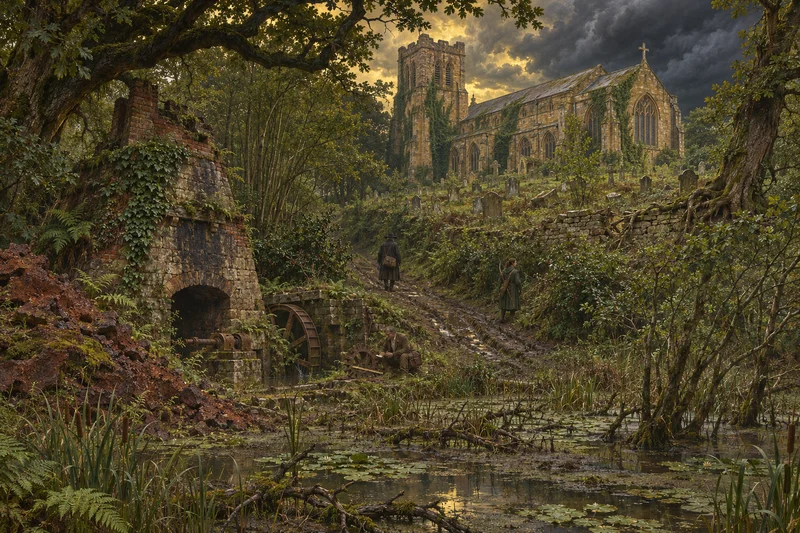
What the furnaces left behind is still there to be seen. There are hammer ponds lying still and grey among the trees, furnace sites under bramble, old workings, cart tracks that join villages on old maps and are now kept by no one, and parishes whose churches were built for three times the souls they now hold. Four of the old furnace villages have shrunk to three farms and a church apiece, the churchyards beside them belonging to no one who can attend them. The Weald is now far poorer than any other part of Kent. It is not derelict, only a country left with one living where once it had two, cutting coppice for other men's hop poles and burning charcoal.
Between the first frost and the close of March the clay closes the lanes to any loaded cart, and the poorer lanes are left unmended through the winter. A Wealden household may then go a month without seeing its neighbouring market. Visitors from the crowded north of the county find the silence of the place oppressive. Its houses are weatherboarded and hung with tile, its news comes by pole buyer, charcoal family, carrier and parson, and a good coppice-judge or a burner whose charcoal has never spoiled a load may be famous in six parishes and unknown beyond them. In the west the greater lordship and most of the timber are House Ashcombe's.
The Weald has its own cautions. Kentish carters will go anywhere by day, but there are about a dozen Wealden lanes they will not enter after dusk, and they will go eleven miles round rather than three straight through without saying why. Four parishes keep an old rule that no house may be left empty through a winter, and they say it is only because empty houses fall down. A stranger is well advised not to sleep in one that does.
Where the volumes speak of it
- Book V › Chapter 1 — Kent at a Glance
- Book V › Chapter 2 — The Look of It, the Weather, and the Crossing Season
- Book V › Chapter 3 — The Road, the Line, and What Stopped Coming
- Book V › 23.2 The Gardens, the Poles, and the Oast
- Book V › 22.4 What a Bad Season Looks Like
In the Chronicle
Met here
Faces found here

Within The Weald
 VillageAbbot's WealdAbbot's Weald is a Wealden village where Justice's Clerk Anne Moyle keeps the clerk's table. She writes from here to the Maidstone bench about the witch accusations of a…Wood and orchardAshcombe WoodsAshcombe is managed woodland and coppice owned by House Ashcombe, the Green Boughs, whose strength is timber, estate improvement and game. It supplies oak and ash…
 Region · Fringe · 1 withinThe Dead Furnace ParishesThe Weald's iron trade once fed whole villages, and when it stopped they dwindled away, leaving four furnace parishes that are now a few farms and a building: a church…VillageGorsehurstGorsehurst is a hop parish in the Weald of Kent. The excise officer Walter Hothfield weighs each hop pocket at the kiln there, and between August and October he is the…Road and wayGorsehurst RoadThe Gorsehurst road is one of two roads, the other being the Tonbridge road, that lead south from Maidstone into the Weald. Since 4619 it has been worked by Nell Bassett…VillageHollins GreenHollins Green is a settlement in the Weald of Kent. For two decades Joseph Pudsey has supplied three parishes with preserving salts made without a licence. In August a…Abandoned ruin · Feral groundSlagmere Hammer PondThe bay still holds back a long reach of black water, but the wheel pit is choked and the furnace is a ring of cinder under bracken. Fallow cart tracks lead to it from…House and estateThornley GrangeThe clearing cost a good sergeant, Ned Cobb, who went into the cellar alone and was found sitting upright with his eyes open. The house has stood empty since. Wealden…
 RegionThe Western WealdThe western Weald is the wooded, timber-producing part of western Kent, lying within the wider Weald. It is the district where House Ashcombe, called the Green Boughs,…

