Region · Feral ground · The High South
Oxford Marsh
The Oxford marsh belt is the wet country about Oxford that was the ground of the Oxford Marsh Campaigns, which ended with the Reedwater Terms of 3716. Some ground was surrendered for good and certain crossings were kept, on terms made with the marsh itself. Its fights include those at Saint Jude's Ford and along Black Orchard Lane.
History and lore
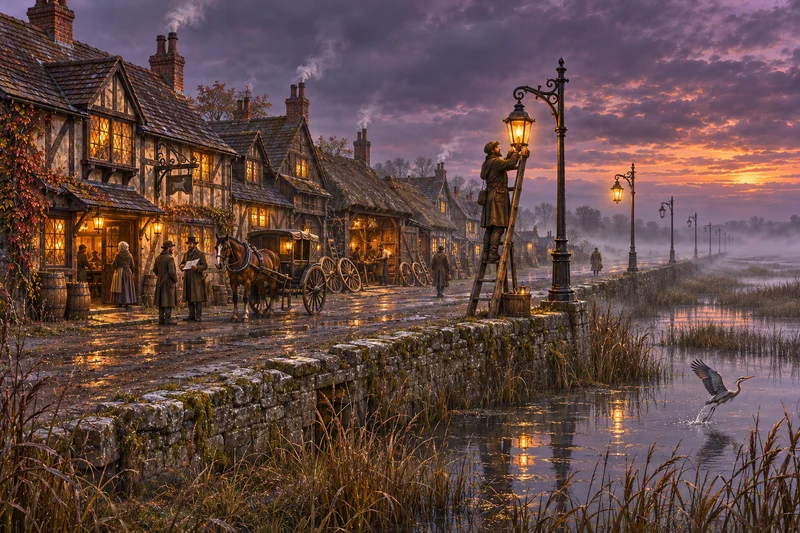
North and west of Oxford the dry ground gives out. What lies beyond is a wide, unfinished country of reed, fen and black standing water, crossed by causeways that never stay where they were built. For three hundred years the city has drained it, banked it and fought it, and the work has never been finished. The marsh is the reason Oxford's writ stops where it does, and the reason the belt has any frontier. Its dangers are water that passes for solid ground, causeys that end wherever the last season left them, cold, fog, and a long way to the nearest voice. It is the one country in the belt that truly kills, and the people who live beside it say that it takes a man quietly, from the back of the line, so that he is not missed until the crossing is done.
The oldest fighting anyone in the region set down was fought here, in the Marsh Campaigns that began in 3708. They had no enemy in the usual sense. For eight years men tried to master the wet ground and lost, and in 3716, in the same season that men fought at Saint Jude's Ford, they settled on the Reedwater Terms instead: an agreement made with the marsh itself, not imposed upon it. Some ground was given up for ever, some crossings kept, and observances promised that are still carried on by people who no longer know why. The Reed Cross of Saint Frideswide is what survived the end of the campaigns, and the causeys are still walked after dark by lantern rules that an early mother of the order laid down. Later ages added their own scars, the worst in 4287, when Reedgate was cut by night in a quarrel over causey labour and six settlements drowned; the breach is open water still, called the Cut. Black Orchard Lane is another old name the marsh speaks of carefully: a route that was, in the local phrase, corrected, and which people still keep away from at night without saying why.
Today the line starts at the Cut in the west, follows Reedgate, turns at the Black Fen fork and ends on the rising ground beyond Little Mere to the east, and in seventy years it has barely moved. Beyond it is the marsh proper, crossed by three kept causeys and by paths the keepers know and do not share. Each causey has its stations at intervals, small houses of stone or timber, each with its bell and lamp, food and fuel laid by, and a bed or two. A party signs at every one, and if it fails to arrive the Causey Wardens know it within the day.
The people of the marsh edge keep lamps, cut reed, take fowl, run ferries and hold the crossings, settled and capable folk with their own saints and a long memory of standing between Oxford and the wet while Oxford pretended not to need them. The water gives back what it takes, sometimes years later: the dead, who are buried by the Reed Cross where they can be named, and lost goods, which by custom must be carried to a station and written in. On Reed Lantern Night the keepers take on extra lamp-bearers at a shilling and a supper, and the marsh folk have a saying for newcomers that the causey is the road and everything else is the marsh's own.
Where the volumes speak of it
- Site › Chronicle of the Realm › Fight at Saint Jude’s Ford
- Site › Chronicle of the Realm › Reedwater Terms
- Site › Chronicle of the Realm › Black Orchard Lane Correction
- Book III › Chapter 3 — The Thames Corridor, the Marsh, and the Roads Between
- Book III › Chapter 26 — The Marsh Villages
- Book III › Chapter 28 — The Ground Before the Cities
- Site › Powers of the Realm › Order of Saint Frideswide's Reed Cross
- Book III › Chapter 3 — The Thames Corridor, the Marsh, and the Roads Between › 3.2 The Oxf
Powers seated here
- Causey Wardens of Saint Frideswide
- Marsh deanery
- Netherhythe hythe
- Order of Saint Frideswide's Reed Cross
In the Chronicle
Faces found here

Warden George Bell
Warden of the Oxford Marsh Campaigns Joan Reed
Mother of Little Mere Matthis Crowmere
The First Ferrylord of Crowmere
Brother Oliver Wardlow
"The Fowler", Leader of the warpriests of the Reed Cross Mother Hildeburh
"The Lantern Mother", Mother of the Reed Cross; author of The Mersshe Candel Instrucciouns Warden Poole
Warden of the Reedgate station, Causey Wardens of Saint FrideswideWithin Oxford Marsh
Church and shrine
Crossing
 Crossing · FringeBlack Fen ForkBlack Fen Fork is a named crossing of the Oxford marsh. Like Saint Jude's Ford, it has households living at it year-round and a long record of disputes. It gives its…
 CrossingThe Crowmere CrossingThe first Matthis Crowmere ferried the warden's columns by day and the marsh households by night, and when the Reedwater Terms were made in 3716 his crossing was one of…Crossing · FringeSaint Jude’s FordSaint Jude's Ford is a crossing of the Oxford marsh, named alongside Black Fen Fork. Households live at it year-round and it has a long record of disputes. A fight took…
Fen and mere
Fen and mere · Feral groundBlack FenBlack Fen is a wet fenland on the line of the reclaimed Oxford marsh, where the defended line turns at Black Fen Fork before running east towards Little Mere. It is…Fen and mereBlack ReedsThe Black Reeds are named for the Reed Sickness, a blight of the marsh and the damp margins of the valleys. Beds turn black from the root over a season, the water under…Fen and mere · Feral groundThe CutThe Cut is open water in the marsh at the edge of Oxford, where the Reedgate causey was breached in 4287 and the ground was never recovered. The present causey runs…Fen and mere · Feral groundThe Offering PoolsAcross the marsh, households and parishes put small things into named waters at named times, never calling it worship; it is done at the meres, the four named crossings…Fen and mere · FringeWhite ReedsWhite Reeds is the marsh district at Oxford's edge that was opened again in 4591 in the Second Keeping. Engineers, clergy of the parishes, crews from the dredgers and a…Haunted ground
Place
River and water
Road and way
Road and way · Feral groundBlack Orchard LaneBlack Orchard Lane is a route through the Oxford marsh country that the marsh says was corrected, its word for a thing the chapter chose not to describe in plain terms.…Road and wayCauseway at Saint Frideswide’s CutThe Causeway at Saint Frideswide's Cut is the newest of the Oxford marsh's major works and the costliest to build. The account of the marsh's crossings names it together…Road and way · Feral groundThe Keepers' PathsPast the line at Oxford's edge the true marsh begins; three kept causeys cross it, and beside them run an unknown number of ways the keepers use and never make public.…Road and wayThe Marsh CausewayIn 4468 Curate Simeon Colley baptised seven Afflicted children here by lantern light, from a pewter basin filled from the marsh, after their parish church had shut its…Road and wayReedgate CauseyThe principal causey of the marsh and the busiest place in it. In 4287, during a labour dispute, men cut it at the deepest channel by night; eleven miles flooded, at…Village
 Village · FringeCausey EndCausey End is a village of about a hundred and thirty people on a raised road some four hundred yards long, which carries travellers over the Oxford Marsh. It lives…Village · FringeLittle MereThe largest settlement behind the marsh line, holding about four hundred people, with a chapel, a pair of inns, a reed market and a Reed Cross station where travellers…VillageNetherhytheNetherhythe is a river port with no river. About 220 people live beside a stone quay, a crane and a customs house, none of which is within four hundred yards of a…

