Works and stores · The High South
Glassmere
Glassmere is the glass and lens yard under Lens Row in Cambridge, held by the Glassmere Company, which also makes sealed vessels. Its vaults store essence, and its Conduction Rooms test spirit influence as conduit or catalyst, the usual destination of sealed finds from retrieval parties. Spirit and demonic essence and the parts of dangerous creatures are lawfully bought, examined and papered here, the traffic resting on the amendment of 4189, and nothing crosses its market unpapered. Glassmere is counted with Stonecourt and Blue Kiln among the craft trades whose men shape apprenticeship and demarcation.
History and lore
Glassmere is the glass and lens yard under Lens Row in Cambridge, a cluster of glasshouses, kilns and vaults behind an iron gate. It began as a lens grinders' yard, when Cambridge's assayers needed better glass than London would sell them. The grinders learned to make sealed vessels that would hold what the deep workings gave up, and the vessels made the yard's fortune. The Glassmere Company was chartered to hold the yard.
Under the amendment of 4189 Glassmere became the one lawful market in the realm where spirit and demonic essence, and the parts of dangerous creatures, may be bought, examined and papered. Nothing crosses its market without papers. Retrieval parties bring their sealed finds here; the examiners take them in, test them in the Conduction Rooms, and either paper them for sale or condemn them. The vaults beneath hold essence in numbered vessels under Warden Martin Quince, who treats a broken vessel not as an accident but as a breach.
The grinders of Lens Row, Milo Crow's family among them, still work above the vaults, and still find ground glass in their bread. With Stonecourt and Blue Kiln, Glassmere is one of the three yards whose men decide apprenticeship and demarcation in Cambridge, and its workers drink and marry within the trade. The Beaumonts count it as part of their domain of assay, and the Company does not argue with them in public. Blue Kiln fires Glassmere's crucibles, and the two yards argue constantly about which is to blame when one fails.
A company that brings in an unpapered find will be told politely to take it out again or hand it over. A company that tries to sell one elsewhere in Cambridge will be visited by the Company's wardens before nightfall. A company that brings in something the examiners have never seen will be asked to wait, and then to wait longer, and then to answer a great many questions. The examiners have long memories, and they share them with the wardens.
Where the volumes speak of it
- Book III › Chapter 13 — Manufacture, Novelty, and the Ingredient Market › 13.5 Essence: Spirit and Demonic
- Book III › Chapter 13 — Manufacture, Novelty, and the Ingredient Market › 13.6 Mutant and Monster Parts
- LiB2 › Chapter 3 — Cambridge › 3.3 Yards, Works, and Schola Buildings
- Book III › 14.2 Stonecourt, Blue Kiln, and Glassmere
- Book III › 13.5 Essence: Spirit and Demonic
- Book III › 13.6 Mutant and Monster Parts
- LiB1 Addendum › Glossary
- LiB1 Addendum › A.9 Wards, Workings, and the Trade in Essence and Parts
Powers seated here
In the Chronicle
Met here
Faces found here


Within Glassmere
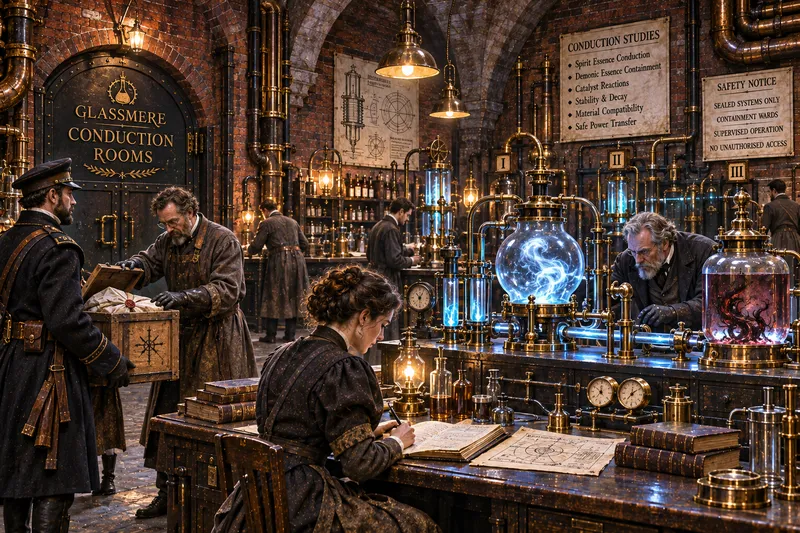 BuildingConduction RoomsThe Conduction Rooms are the testing rooms at Glassmere in Cambridge. There a spirit influence is studied as a conduit or catalyst in arcane work without being granted…
 MarketGlassmere MarketGlassmere Market stands inside the Glassmere works at Cambridge. It sells lawful essence and creature parts and keeps vaults in which to hold them, and it lets nothing…

