City · Kent and the Narrow Sea
Dover
Dover follows the tide, not the clock: when the water demands it, work begins before dawn and victuallers serve the gangs from two o'clock. Its wealthier families live on rising streets behind the western quay, not behind park walls. Authority rests on custom: the port-reeve closes the quays before gales unwarranted, pilots hold a monopoly guarded by a book, and packets sail to a public calendar.
- Within
- Kent and the Narrow Sea
- Holds
- 100 places, 63 directly
- Named in
- Book I, Book V
History and lore
Dover was held early: a milestone of the West March near the town carries an inscription of about 3922, and for four centuries afterwards the county treated its watch on the water as a formality. Three troubles taught it otherwise, and Kent tells them together. The Pilot Wars of 4248 to 4253, fought among Britannian pilot companies with continental money behind them, ended with the Quay Office, a licensed roll of forty-one names and nine stretches of water. The earthquake and cliff-falls of 4336 damaged the approaches, two harbour towers and several chalk roads. The pilots twice stopped the port by staying ashore, in 4388 and 4571, until proposals to let outsiders vote on the roll were withdrawn. Between 4441 and 4448 the War of the Azure Banner brought convoy, dearer insurance and from 4448 the packet calendar; the underwriters' surcharge of a third for a lone winter hull followed in 4462. The Black Wake of 4615 to 4617 left moved bearings, a rewritten calendar, a refusal to insure the old headings and a roll that carried forty-four names for nineteen months before returning to forty-one.
The town is squeezed between two cliffs and its harbour and runs to the tide: wages are paid by the tide, in a bad week victuallers unbar their doors at two in the morning, and a quay roaring at three in the morning one week is silent at that hour a fortnight on. Camber and Archcliffe are the licensed quays, the eastern quay worked by nine gangs and the western by seven, each a family or two before it is a gang. The better sort live on Archcliffe Rise behind the western quay; the garrison holds Highward on the eastern height, beside the fenced masts where sky vessels come down. Authority is custom. Port-Reeve Eustace Marr, who holds no warrant, has shut the quays nineteen times in twenty years, been wrong twice and said so publicly both times. The licensing session of 4466 decided that a working port is a drinking port, so sixty-one houses are licensed. Rachel Folkestone's room prices the Narrow Sea, and Master Shipwright Elias Redd's repair book decides what floats insured.
At the eastern quay's head hangs a flat old bell, rung before every closure for a reason written nowhere; it is older than the quay, and four antiquaries have read its inscription four ways. Three gangs will not resume until it has been rung again. Between the new year and the first of March, no load goes up that quay after dark. The town says, when pressed, that the ground beneath was foreshore where Dover buried its drowned for three centuries, and leaves the rest unsaid. Lately Tide-Waiter Ezra Kitney was found dry and unmarked against the bell post after a closure, his warrant book gone, and the coroner wrote no cause.
A traveller should book the crossing days ahead, expect the dearest beds in the south, and learn the quay's words: a man the water kept was held, one who could have come was wanted. Avoid the houses on the Hill, decline the free trade's offers politely, and take trouble to the watch in Gaol Lane. When Maud Sandown calls the water shut, the argument is over.
Where the volumes speak of it
- Book V › 4.1 The Quays, the Tide, and What Can Be Worked
- Book V › 4.5 The Victuallers, the Lodgings, and What Dover Charges
- Book V › 4.7 The Counting Houses, the Western Yard, and Who Owns the Water
- Book V › Chapter 32 — What a Wage Buys at Dover
- Book V › 37.4 Why the Three Are Told Together
- Book I › Chapter 3 — The World and Its Horizons › 3.5 The Distances, in Miles and in Days
- Book I › Chapter 14 — From Britannia to the Wider World › 14.2 The Narrow Sea, the Near Coast, and the Continent
- Book I › Chapter 20 — The Lands across the Water
Powers seated here
- Admiralty
- Archcliffe Yard
- Blue Ledger Company
- Coast commission
- Company of Soundings and Scales
- Coroner's office of the coast
- Dover customs house
- Dover garrison
- The Dover Packet
- Dover Packet Office
- Dover packet service
- Dover parish overseers
- Dover pilots' roll
- Dover Quay Office
- Dover room
- Dover ropewalk
- Dover watch
- Gloam
- Guild of the Long Censer
- Kentish company houses
- Surveyors' Hall
- White Salt Exchange
- Boarding masters of Dover
- Quay Fifteen
- House Kingsmill
- Narrow Sea Squadron
- Dover harbour board
- Crew of the Kittiwake
In the Chronicle
- The Pilot Wars
- The Settlement of 4253
- South Coast Earthquake and Cliff-Fall Season
- The pilots' refusal of 4388
- The founding of the Dover packet calendar
- The winter convoy surcharge
- The Dover licensing decision of 4466
- The pilots' refusal of 4571
- The Dover Surf Revenants
- The Packet Office refusal of 4589
- The Packet Office refusal of 4604
- The Black Wake
- The fourth declination
- The pilot roll at forty-four
- The Dover bread rises of 4618
- The Market Fall
Met here
Faces found here

Port-Reeve Eustace Marr
Port-Reeve of Dover Elias Redd
Master Shipwright Sir James-Cedric Harcourt
Captain of the Azure Banner war; legation author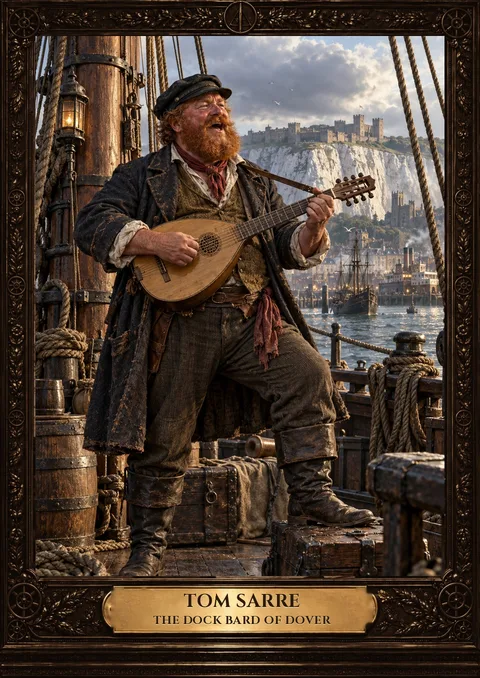
Tom Sarre
The Dock Bard of Dover Cherry Frizzell
Orange Girl of the Sea Horse Odile Jaquemart
The Lace Dealer's Daughter Letitia Kingsmill
The Packet Owner's Daughter Dick Kenward
Boxer of the Eastern Quay Sam Jakeman
Door-Keeper of the Quay Sister Maud Halstow
"Salt Psalm", Coastal Pacifier Simeon Rudd
"The Blind Eye", Customs riding officer on the take Peg Coppinger
"The Anchor", Landlady and receiver of smuggled goods Matthias Hougham
"Jurat Hougham", Jurat of the Dover bench Captain Ralph Kingsdown
"The Old Pilot", Senior elder of the Dover pilots Imogen Tresize
"The Manifest", Inquiry agent of shipping and customs frauds, Dover Alfie Coombs
Stable lad at a Dover coaching inn Oliver Kingsdown
"Young Kingsdown", Apprentice pilot of Dover Hal Witheridge
"Mittens", Fisherman of a Dover lugger crew Adam Ruther
"The Human Compass", Smugglers' pilot of the Narrow Sea
Prince Lionel, Duke of Clarence
"The Warden", Duke of Clarence and Lord Warden of the Cinque Ports Sir Oliver Treharne
"The Harbour Baronet", Baronet of Dover, chairman of the harbour board Commodore James Halloway
"Weather Halloway", Commodore of the Narrow Sea Squadron Captain Silvanus Kettering
"Long Tide", Captain of the Narrow Sea Revenue Cutters Colonel Benedict Ayre
"The Old Gate", Governor of Dover CastleWithin Dover
Building
 BuildingThe Crossed OarsThe Crossed Oars is the company house on the Dover quays, where bands go to be placed and to arrange crossings. Agent Mary Alkham keeps the ledger of crossings, while…
 BuildingDover Customs HouseA stone Crown office set back from the Dover water front, answerable to Westminster and so apart from the rest of the port. Nine officers who rarely move away compare…BuildingDover GuildhallThe Dover corporation's hall, where borough minutes and civic accounts are kept. Its books record the yearly sums for oil to light the head of the eastern quay in…BuildingDover Packet OfficeThe Dover Packet Office stands on Packet Lane and holds the packet calendar and the mails. The calendar is a book fixed by a chain to a table in an unheated room open to…BuildingDover Quay OfficeThe Dover Quay Office was constituted at the end of the Pilot Wars of 4248 to 4253, when a licensed roll of pilots was drawn up and the water divided among them. It…BuildingThe Dover RoomThe Dover room is the body of local underwriters at Dover, to which Rachel Folkestone and Josiah Sandwich belong, with the chart-maker Osbert Fordwich also counted among…BuildingPhilpott'sPhilpott's is a stationer's shop in Dover, kept by Ann Philpott, selling paper, ink and the board copy from the long room for sixpence, counted among the town's three…BuildingThe Reeve's RoomA room on the upper floor over the quay at Dover, where Port-Reeve Eustace Marr settles port quarrels and receives all comers with two ledgers open. Marr has been known…BuildingTrinity AlmshouseTrinity Almshouse stands in the upper town of Dover and shelters widows. It is maintained jointly by the town corporation and a pair of county families, and is one of…
Burial ground
Burial groundDover Foreshore PlotsUnconsecrated burial ground above the tide line at Dover, where the drowned and the bodiless are laid. Beach men dig it for pay, since the town has no village custom to…Burial groundDover Parish GroundA consecrated half acre where the overseers bury people the burial clubs cannot cover. Long ago overfilled, it is packed with shallow, close graves, and no rite exists…Church and shrine
Church and shrineSaint Elric's LanternSaint Elric's Lantern rises on the Dover side of the cliffs above a worked landing, serving as lighthouse and chapel together without any firm boundary between them.…Church and shrineSaint Martin'sSaint Martin's is the borough's parish church, in the upper town, with its vestry in charge and the overseers' room beside it. The adjoining parish ground, half an acre…Coast and rock
Coast and rockDover BeachThe Beach is the shingle east of the quays at Dover, where between forty and ninety men live according to the season in three unpermitted sheds. Waterman Silas Hoo…Coast and rock · 1 withinHollowsand GapHollowsand Gap is a small landing of eleven houses on the Kent shore beneath the South Foreland, close to Dover. Four men drowned in the October gale were washed up…District
Field and heath
Fortress

Hill and down
House and estate
Inn and venue
Inn and venueThe Anchor and HopeA Dover quay public house. Its licensee holds the burial-club box, the mail and the credit slate in the back parlour, and the barmaid exchanges seamen's foreign money at…Inn and venueThe Black HorseThe Black Horse stands on the Hill at Dover and caters to the road trade, under Landlord George Epps. Two affrays of the last ten years are laid to its door. A visitor…Inn and venueThe Crown and CalendarThe Crown and Calendar is the principal coaching inn of Dover, standing at the foot of the Hill. Its yard keeps time with the packet calendar, a fresh copy of which is…Inn and venueGrace Snodland'sGrace Snodland's is a licensed house in Dover's lower street, near the quays, kept by Licensee Grace Snodland, who is as careful with her ledger as with her cellar. She…Inn and venueThe GrapnelThe Grapnel is a drinking house at the top of the shingle by the Dover quays, kept by Sarah Laker, who never asks a customer's name and looks for the same discretion in…Inn and venueThe King's HeadThe King's Head is the inn at Dover for carriers and outside passengers, higher up the Hill than the principal coaching inn, the Crown and Calendar. Landlord Thomas…Inn and venueThe Lord WardenThe Lord Warden is a public house in the quay streets of Dover, kept by Publican Ellen Swingfield, and the seat of a burial club whose pennies are tallied at the table…Inn and venueMary Snodland'sMary Snodland's is a tavern in Dover's quay streets, four doors from the Mermaid, where Mary Snodland has presided for nineteen years. Dock gangs settle their accounts…Inn and venueThe Pilot BoatThe Pilot Boat is the pilots' own house, placed where the eastern quay begins its run at Dover, at its head under Landlord Edward Coveney. It holds roll dinners four…Inn and venueSamuel Charlton'sSamuel Charlton's is a victualling house on the Dover quays, kept by Victualler Samuel Charlton. The fire there has stayed lit since October, and some forty households…Inn and venueThe Three MarinersCoaches come in from London and travellers go down to the boats from its yard. Alfie Coombs works as stable lad there and sleeps in the hay loft. Its yard sees every…Inn and venueThe Tide WaiterA house by the customs house yard at Dover, kept by Landlord Henry Pilcher, for tide-waiters, boatmen and porters. It is also the sporting house of the Quay Fifteen,…Market
Neighbourhood
Palace and tower

Port and quay
Port and quay · 1 withinCamber QuayCamber Quay is the innermost of Dover's licensed quays, a tidal berth that lies as mud for a third of the day. It holds the hoys and small coasters, and it takes the…Port and quayChalk HarbourChalk Harbour lies near Dover. A fight there is remembered from the Dover Pilot Wars of 4248 to 4253, though no account of it survives.Port and quayDover Cutter QuayCaptain Silvanus Kettering commands the cutters from here: three hulls on paper, one on station at a time. Free traders watch the quay to see which hull is in. Kettering…Port and quayDover quaysThe Dover quays form the port's working front. Hands are taken on in gangs for each tide at slightly over a shilling, so earnings range from eight shillings in a strong…Port and quay · 1 withinThe Eastern QuayDover's chief working front, divided among nine family gangs who are paid by the tide, in coin, at the quay head. Quarrels over berths and pay are heard by the…Port and quayThe Western QuayThe western quay of Dover, worked by its own gang and reckoned for by a woman who keeps a private count of the men hurt there over eleven years. Four of the streets…River and water
Road and way
Road and wayCliff StairCliff Stair is a stepped path cut into the cliff, one hundred and forty steps rising from Dover's quay to Archcliffe Rise, the quarter of underwriters, factors and…Road and wayDover Packet StairThe packet stair is the landing on Camber Quay where Dover's passengers step ashore. Porter Ned Coppin, who wears the brass ticket, looks after luggage, and arrivals are…Road and way · 2 withinHighward HillHighward Hill is the garrison road rising up the eastern height of Dover toward Highward. The Gun and the Royal Oak stand on it, the latter kept by Luke Sladden, a…Road and wayOld Crane StairsOld Crane Stairs are public steps at Dover between the quays, used by watermen and little craft. No crane remains but the name stayed. Ferry-Speaker Judith Elmsted…Road and way · 2 withinPacket LanePacket Lane is a Dover street going up from the packet stair as far as the Quay Office, thick with arriving passengers and baggage carts. A porters' bench stands along…Road and waySaint Elric's PathSaint Elric's Path is a cliff walk at Dover, beginning at the top of Cliff Stair and leading along the clifftop to the Lantern above the landing. Families stroll it on…Road and way · 1 withinWalk LaneWalk Lane is a quarter-mile lane in western Dover, running along the ropewalk behind Archcliffe and lined with the cottages of the rope-makers. It forms part of the…Street and square
Street and square · 4 withinArchcliffe RiseArchcliffe Rise is a group of rising streets above Dover's western quay, where underwriters, factors and packet families have their finer houses. The Three Kings,…Street and square · 1 withinChalk LaneChalk Lane runs beneath the eastern cliff at Dover and holds carriers' yards and a horse pond. At its head is the Chalk Horse, run by Landlord Abel Sackett, with a long…Street and square · 1 withinCooper's RowCooper's Row is a street between Dover's two quays that holds the cooperages and cask stores serving the victualling trade. The Sea Horse, kept by Landlord Nicholas…Street and square · 4 withinCustoms RowCustoms Row is a Dover street beside the customs house, lined with narrow offices that serve packet passengers. Notaries attest copies and signatures there, and changers…Street and square · 2 withinFish StreetFish Street lies behind Camber Quay in Dover, and it is where the town's fishing boats unload directly into the market. The fish-wives at the stalls, rather than the…Street and square · 1 withinGaol LaneGaol Lane is the street from which Dover is policed. The borough's watch-house stands in it, where the beadle, Walter Charing, and his two constables take down…Street and squareThe HillThe Hill is the slope down which the Canterbury road enters Dover, lined with inns for coach passengers and carters. The principal coaching inn, the Crown and Calendar,…Street and square · 2 withinLimekiln StreetLimekiln Street is the longest of Dover's quay streets and lies nearest the tanyard. Strangers asking for a cheap room are sent here first. A room means a bed, a box,…Street and squareThe Lower StreetThe street at Dover below Limekiln Street, running toward the water. Its houses are divided and let by the room or half-room, and lodgers meet Rent-Collector Joan…Works and stores
Works and storesBax'sBax's is a shop in the four streets behind Dover's western quay, kept by Widow Sophia Bax. It sells jars, vinegars and seed cakes in the Near-Coast style, much of which…Works and storesThe Customs Detention ShedThe Customs Detention Shed is an old brick store in the customs yard at Dover, with one door and two locks, the key to each held by a different officer, so that both…Works and storesDover RopewalkThe Dover ropewalk is the long cordage works behind Archcliffe, a straight quarter-mile in length, among the private works built against Crown ground there. It employs…Works and storesMother Kember'sMother Kember's is the shop of Mother Ruth Kember, who takes pledges and receives goods at Dover from a back room behind a chandler's curtain, near the water. She…Works and storesWingham's KitchenWingham's Kitchen is the home workroom of the bone-setter Josiah Wingham, in the quay streets of Dover. The packet crews have their own physician, but the quay gangs…
