
District · London
Commons
The Lower City is the old, low-lying part of London, also called the Commons, and the part of the capital where labour, cellars and tide stairs are concentrated. Common thought treats it as both working infrastructure and a moral warning, and people speak of what lies beneath it with the caution they give deep water. It was razed in large part by the Great Fire of 4487 and again scorched in 4556.
History and lore
The Commons, or Lower City, is the old low-lying body of London, laid over the buried city and under the raised platforms of Westminster. It grew from the river footholds of the reclamation, from Bridegate and Westminster Rise, through the Ash Scouring of 4041 and the hardening of the capital by pumps, bridges and yards between 4084 and 4116. Twice it has burned. In 4487 the first Great Fire, wind-driven, burned for fourteen days and razed wide stretches of it before demolition, pumps and exhaustion stopped it at the lower edge of the High City. The second, in 4556, broke out of Southbank and White Dock, from their varnish, oil and timber yards, and ran eight days through the river wards. Warehouse spacing hardened after the first, the law on lamps and volatile stores after the second.
Where the volumes speak of it
- Book I › Chapter 8 — London and the Lower Thames: The Capital Lens › 8.4 Thresholds, undercity, and dependence
- Book I › Chapter 8 — London and the Lower Thames: The Capital Lens › 8.5 Labour, rumour, and the memory of fire
- Book I › Chapter 8 — London and the Lower Thames: The Capital Lens › 8.6 The city above and below
- Site › Chronicle of the Realm › The Great Fire
- Book II › Chapter 17 — Law, Archives, Hospitals, and the Keeping of the Dead › 17.8 Physicians, Surgeons, Apothecaries, and the Medical Market
- Book II › Chapter 22 — The Undercity: Old City, Gutters, Sewers, and Lawful Descent › 22.8 Regional Touched beneath the city
Powers seated here
In the Chronicle
Faces found here
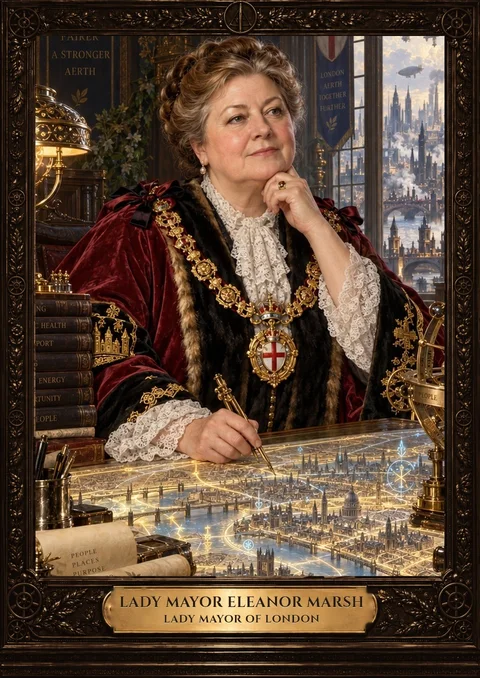
Lady Mayor Eleanor Marsh
Lady Mayor of London
Father Rowan Dene
Priest of the London Thresholds Colonel Osbert Fell
Officer of the London Militia Jonah Whitcombe
Grave-Master of London Kit Verrall
Nightstairs Combine John Nicholas Pike
Keeper of the Hall of Curiosities Tobias Fenner
"Soot", the Sweep's Boy Isaac Crowe
"Tin", the Black-Opium Boy Mercy Vell
Of the Cellar Supper Room Naomi Calder
Dancer of the Pleasure Hall Connie Firth
Of the Blue Lantern Mara Fenwick
"Gauge", Pressure-Line EngineerWithin Commons
Building
 BuildingBethlem HouseLondon's most famous and most feared refuge for the mentally ill, standing in the Commons. It is something between a hospital, a spectacle and a prison, and is used for…BuildingHall of CuriositiesThe Hall of Curiosities is an exhibition house in the London Commons, kept by John Nicholas Pike, which exhibits recovered finds after they have been rendered harmless.…BuildingThe London Burial OfficesThey coordinate corpse routes, grave assignments, church business and the prevention of grave theft, and belong to the stern, custodial side of London's government.…BuildingNewgate GaolNewgate Gaol is the great civic prison of the London Commons. It takes common criminals, the condemned, men wrecked by debt and anyone awaiting trial, sentence or…BuildingThe Office of Burial CorrectionFamilies in trouble are as likely to be sent here as to any cathedral. Father Dene is more often found in a wet yard with a family than at his desk, and he tends to know…BuildingSaint Anne's InfirmarySaint Anne's Infirmary is a house in the Commons that combines nursing, alms, surgery and maternity work, drawing on women's labour, church charity and lower-city…
Church and shrine
District
District · 11 withinBlackfriarsA district of London on the river, home to the Noctuary Club, a society for dining and reading with a strong sense of the city's past. Edmund Vaun's painting Rain at…District · 1 withinBoilerfieldsBoilerfields is a district of the London Commons where the heavier works stand, along with Ironbank. It is known by its shift whistles and the warmth of its steam mains.…District · 3 withinCheapsideCheapside is a district of the London Commons with shops along its front and old-clothes wards behind. Rag Fair lies behind it, and Blind Nan Rolt, the best-known ballad…DistrictEastmereEastmere is an old ward of the London Commons, proud of its parish bells. Its bell team has a rival in Millbank's, which has staked sixty pounds at the Five Bells on…District · 2 withinGreywaterGreywater is a part of London where salvage men work, tied to the undercity and to chemical and technical trades. Hester Grayshott is the person to ask about Greywater…District · 4 withinHolbornHolborn is a district of the London Commons, below the hill, where the common price scale holds. The Swan with Two Necks, the greatest coaching yard, stands there,…District · 2 withinSaint Olave’s WardSaint Olave's Ward is an old parish quarter of the London Commons, centred on Saint Olave's Graveyard, and it is counted parish country, like Eastmere beside it. Ward…Field and heath
House and estate
House and estate · 1 withinBell CourtA lane in London so narrow that no corpse cart could turn in it, yet the Late Cart is heard there on wet nights, wheels and burial bell together. Funeral officers…House and estate · 2 withinCrowswell CourtCrowswell Court is a court in the London Commons, known for modest debt and thin gentility, its people living a missed payment away from public embarrassment.…Inn and venue
Inn and venueThe Blue LanternThe Blue Lantern is a modest house of the Lower City in London, owned by Mr Josiah Kemble and run day to day by Connie Firth, who arranges its shifts, pays its wages and…Inn and venueThe Cellar ClubThe Cellar Club is a members' club of the Lower City in London, kept below street level, whose members and rooms are little talked of; most Londoners know it only as the…Inn and venueThe Cellar Supper RoomIts staff wear black with starched white aprons, and the house rule is that no one touches them. A private room behind serves suppers whose guests expect not to be…Inn and venueThe Fourteen FiresThe Fourteen Fires is a house kept by Widow Margaret Pell, among the general houses in the lower part of the Commons in London. It is known for its stew and its din, and…Market
Market · 3 withinBellmarketBellmarket is a part of the London Commons near the water, where public notices are posted and cheap inns gather, and where parish noise and open trade mix. It is named…Market · 2 withinCornhallCornhall is the great market of the London Commons. Market Inspector Abel Dunmow sees that the weights are tested ahead of the opening bell. Cheesemongers such as Jethro…Port and quay
Road and way
Road and wayAsh Lane Chapel CloseAsh Lane Chapel Close is a devotional pocket the size of a lane, in the Commons of London, sustained by threshold devotions and holding on despite urban strain.…Road and wayThe Guarded StairStair guards in plain dark coats and brassbound caps check papers at its head and turn back contraband that would dodge the lift by going up on foot. The guards compare…Street and square
Street and squareLantern CourtA small spur in the Commons, off White Lily Passage, which makes less pretence than its neighbour. It is associated with discreet callers, cards, hired musicians and…Street and square · 3 withinLudgate HillLudgate Hill is a London street of undertakers and mourning warehouses, of which Merriman's and Martha Gedge's are the best known. Its furnishing undertakers supply…Works and stores
Works and storesThe Great LiftStewards in the lift company's dark blue tunics, with bell badges, check permits, guide bewildered travellers and keep order in the queues, where flower girls and news…Works and storesRose Sugar HouseA confectioner in the Commons, noted for preserved peel, sugared violets, hard sweets for travellers and expensive wedding boxes. Its customers are homes whose owners…