Village · Kent and the Narrow Sea
Chilham
Chilham is a Kentish village with a bridge. The formula of refusal from the Canterbury Obedience War, first spoken at Bekesbourne, was taken up here within the month, and at the bridge the visitor sent to reclaim obedience was turned back as the whole parish watched. Kent has conducted its arguments over the packet trade, pilotage and harvest in those same words since.
- Within
- Kent and the Narrow Sea
- Holds
- 1 place
- Named in
- Book V
History and lore
Chilham is a Stour valley village standing on a rise above the river, entered by its bridge. No one can say when it was founded, but it was a settled and self-respecting parish by 3942, when the Canterbury Obedience War began. That war was a dispute of procedure rather than faith: the reclaiming authority required each see to accept, in writing, a single centre's ordering of rite, burial and the examination of power, and Canterbury, which had kept the rite and buried its own dead through two centuries of ruin with no instruction from anyone, refused. The words in which Kent refused were first spoken at Bekesbourne, where the bounds were walked against an officer. Within the month they were said again at Chilham.
What happened at Chilham is the scene the county likes best. The visitor sent into Kent to obtain obedience came to the bridge and turned back there, with the whole parish looking on. No blow is recorded and none was needed. The seven years were mostly like that: visitors not received, summonses ignored, burials done in the old form and then defended. The chronicles name four actions of the war and place only Bekesbourne among them; Chilham's bridge is remembered not as a battle but as the plainest picture of what the refusal looked like.
The village today is hops on the level ground, orchard up the slopes and a church, like its neighbours, and it carries its moment lightly. Kent has gone on arguing about the packet trade, pilotage and the harvest in the same words that were used at the bridge, and any carter on the Dover road will tell the whole story inside a day. The tellers tend to stop short of the ending: in 3949 the Canterbury chapter put its name to the obedience, the city never did, and the signed instrument sits openly in the chapter's muniments for anyone who asks. Chilham people are said to point out the spot near the crown of the bridge where the visitor reined in, though no record fixes it.
A traveller crossing the bridge will be welcomed, fed and talked to at length about the hop and the road, in the valley's way, which is warm and closed at once. It is unwise to praise Oxford in the parish, or to mention the signature as though it settled anything. A company wanting work here should look to the Brethren at Wye or to the parishes upstream, not to the bridge's history.
Where the volumes speak of it
- Book V › 36.1 What the Obedience Was, and Who Refused It
- Book V › 36.2 The Seven Years
- Book V › Chapter 36 — The Canterbury Obedience War, 3942 to 3949
In the Chronicle
Faces found here

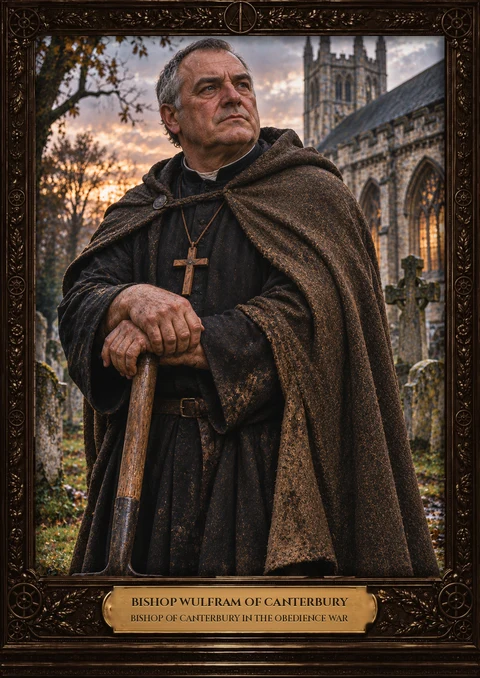
Within Chilham