Church & Clergy
Bishop Anselm Petham
Bishop of Canterbury
Bishop Anselm Petham is Canterbury's bishop. His see gave up the ordering of the rite to Oxford when the Obedience War ended, and held on to its great church, its chapter, its estates and its right to bury. He guards the remainder patiently. Companies meet him through his examiner, Mary Swanton, when a Kentish accusation needs to be written down before anyone is taken.
Anselm Petham was born in 4561 at Petham, a downland parish south of Canterbury from which his family takes its name, the second son of Thomas Petham, a hop grower with a hundred acres, and his wife Alice. He sang as a boy in the cathedral choir and went to the chapter's grammar school, and from there, like every Kentish ordinand, to Oxford for his orders. He has never forgiven Oxford for the necessity, and has never once said so.
He served eleven years as a minor canon in the Precinct, then as archdeacon of the eastern deaneries, riding the coast parishes from Sandwich to Dover on a grey cob that the villages still remember. The chapter chose him in 4605, the Crown confirmed him, and Oxford gave its blessing in the slow, correct way it gives it to Canterbury. He holds the see that Bishop Osbern Fen once defended in writing, and keeps a copy of the Obedience Notes beside his bed.
Three matters mark his rule. In 4609 he refused to let the chapter's certificate of a burial be sold with a manor, and the family that wanted it went to law and lost. In 4613 the Grey Nails took a woman at Otham and burned her on no written information, and Petham, who could not stop them, ordered from that year that nobody in his jurisdiction be taken before his examiner until a named person had set the matter down in writing. Mary Swanton, his examiner, has kept that rule ever since, and holds up the Ashenhurst examinations as the pattern to follow. In 4617 Canon Philip Eastling put to him a seminary in Canterbury, so that Kentish curates might learn the Kentish dead at home; Petham read the paper twice and called it right, and the chapter thanked Eastling for it and could not find four hundred pounds a year.
His ties in the city are close and careful. Lord Bertrand Quayle has kept the nave roof over the shrine for forty years, and Petham welcomes his patronage and not his opinions. Dean Cuthbert Barham runs the chapter, and the bishop lets him, since the chapter's statutes presume a bishop above it and both men know exactly where the line falls. Precentor Hugh Barton is his favourite table companion. Alderman Thomasina Wybourne writes to him about the pilgrim road, and he answers every letter in his own hand.
He wants the see's dignity kept without a quarrel with Oxford, and he knows that the two are not always the same thing. This autumn the matter is a thread that Roderick Vosper sold on the pilgrim road as Saint Ebba's, which has been followed by a child's recovery in Maidstone. Quayle wants it brought to the chapter; Wybourne may send it to Oxford. If Canterbury examines a relic and is wrong, Oxford will say so for a century, and if Oxford examines it, Canterbury will have given away one more thing. Petham would hire a quiet company to learn where the thread truly came from before anyone else decides what it is.
He fears the Grey Nails more than any power in the county, because they answer to nobody and come within a day and a half, and he has no force to set against them but a written rule and a woman who reads it aloud. He is said to have written twice to Westminster about them and received no answer.
It is said in the Precinct that Petham has never once crossed the cathedral threshold without touching the stone where the Obedience was signed. It is also said that he keeps a list of every Kentish ordinand Oxford has failed, with Oxford's reasons, and that it is longer than Oxford's list of those it passed.
“Write it down and sign it. Then I will listen. Otham listened first.”
In person
A broad, solid man of middle height with a countryman's shoulders and a heavy, weathered face, clean-shaven, ruddy at the cheekbones and deeply lined about the eyes. His hair is thick and white and cut short, and his eyebrows are still dark. His eyes are brown, patient and observant. He wears a plain black cassock and a purple stock, a heavy gold cross of old Canterbury work on a chain, and riding boots under the cassock more often than buckled shoes. His hands are large and scarred from boyhood work in the hop gardens. He speaks slowly, with a strong east Kentish burr he has never troubled to lose, and he listens longer than he talks.
- Affiliation
- Church of Britannia
- Born
- c. 4561 A.C.
- Age
- about 60 years old in 4621 Years After Cataclysm. The present day is 4621.
- Active
- Bishop of Canterbury
- Where
- Canterbury · The bishop's palace, the Precinct · Kent and the Narrow SeaCanterbury · Canterbury Cathedral · Kent and the Narrow Sea
- Places
- Canterbury · The Bishop's Palace · Canterbury Cathedral · The Canterbury Precinct
- Calling
- Cleric, Head
- Named with
- Church of Britannia
Often named with
-
 Absalom Writhe"Red Ledger", Witch Hunter and Evidence Investigator
-
 Archbishop Edmund James ValePrincipal archiepiscopal voice at Westminster
-
 Archbishop Oswin HaldenArchbishop of Oxford
-
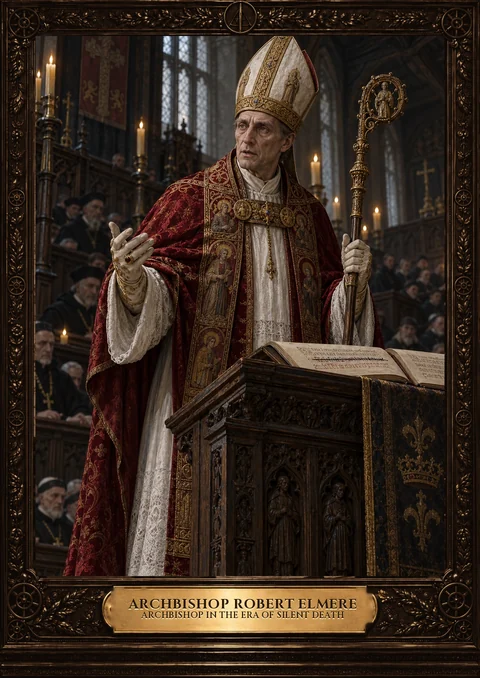 Archbishop Robert ElmereArchbishop in the Era of Silent Death
-
 Bishop Alaric Fenwood"The Probate Bishop", Bishop of the London Consistory
- Bishop George FenmereBishop associated with London’s river parishes

