
Crown & government
The Crown
“The Crown endures”
Also called Crown · Westminster · the throne · Crown government · the realm's offices · Crown offices
Banners and seals
-
 ★ Main emblem “The Crown endures”
-
 “The Crown endures”

The summit authority of Britannia: it gives seal, charter, high warrant, levy and high judgement, stands over the armed realm and the Great Houses, and is the name in which the ministries act. It rules through layered arrangements rather than direct command, tolerating local lords, councils and customs it cannot replace.
The royal government at Westminster, whose reach in the High South runs through requisition, the seven-year line licence, the assizes, the archbishop's appointment and the never-used power to withdraw guild recognition. It keeps fewer officers in the belt than in any comparable region. The realm's sovereign government, working in London through ministries, treasuries, registries, customs boards, seal chambers and superior courts. It stands above the city's civic government and uses London without deriving its authority from it.
Named with it
- King Edmund IV Treaty-King
- Prince Richard
- King Edmund IV
- Prime Minister Sir Alured Marchmont
- Lord Chancellor Thomas Edward Bale
- Lord Treasurer Nathaniel Vane
- Home Secretary Sir Edmund Rooke
- Sir Julian Thornycroft
- Sir Matthew Wetherall
- Comptroller Reuben Vale
- Master Oswin John Fairbridge
- Thomas Edward Bale
- General Roderic Hale
- General David-Laurence March
- Cenred I Ash-Crowned
- Alured I Bridge-King
- Edmund III the Surveyor
- George Nicholas II Bastioner
- Stephen III
- Robert II
- Queen Maud I Reconciler
- Beatrice II Lantern Queen
- Alured II Iron-Prayer
- Master Engineer Aldwin Marr

King Edmund IV
Treaty-King; King of Britannia
Prince Richard
Heir to the Crown King Edmund IV
Treaty-King; King of Britannia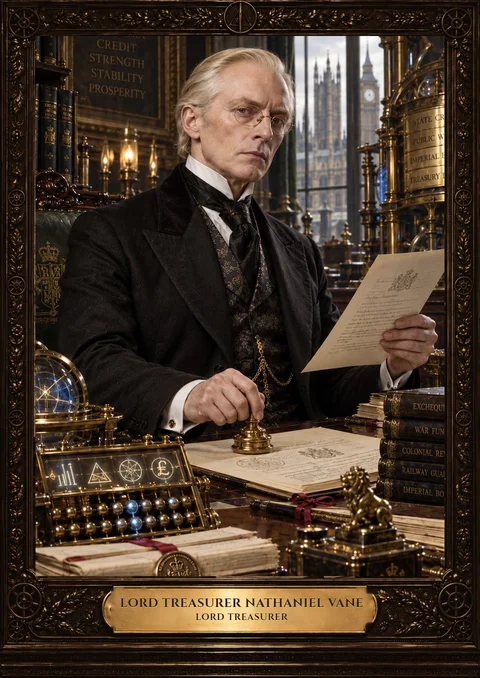
Lord Treasurer Nathaniel Vane
Lord Treasurer
Sir Julian Thornycroft
Foreign Secretary Sir Matthew Wetherall
Minister of Works and Communications Comptroller Reuben Vale
Comptroller of Crown Provisioning
Master Oswin John Fairbridge
Master in the Hall of SealsTies
- headed by the Royal House
- acts through the Ministry and the great offices of state
- stands over the House of Lords and House of Commons
- legal head of the British Church (through the King)
- declares seasons through the Royal Ministry of Survey, Roads, and Provision
- the island Church answers Westminster promptly
- above the Mayoralty of London in constitutional order
- collects many church tithes through Crown-recognised channels
In the chronicle
- · The Stairs Wars
- · The Cold Quay Accord
- · The Crown Charter of 4101
- · The Hazelrigg Assart
- · The First Baron War
- · The Second Baron War
- · Battle-water of the Azure Banner
- · The Great Fire
- · The Refused Request
- · Creation of the Crown surveyor at Sarrum
- · The Crown requisition of the line, 4581
- · The Crown grain requisition of 4602
- · The Halden Refusal
- · The Outer Granary Suspension
- · The Northern Fringes Reclamation Feuds
- · The Baron Wars
- · The Losing of Crowdyke Gate
- · The Stang Head Sitting
At the table
Private war the Crown denounces; rough local powers it tolerates nonetheless, and a mercenary captain who has succeeded it may make lawful after the event, being as quick to ratify a company's success as to disown its failure. By formal Crown order some feral approaches, routes, that is, into wild country, are sealed. Between what Crown paper says and how things lie on the ground there is a gap, and a great deal of southern politics is carried on within it. The Collegium's order of priority puts Crown work first. Both Crown and guild papers draw a line between water actually held and country only claimed. To a Londoner the Crown appears as waiting, as refusal, and as sudden permission; its officials, set beside the city's, are less loved and more feared, and when the Crown wants a thing it comes with great speed. The monarchy's consecration to Saint George having been restored, the name now carries a charge in the culture of the court.
- Kind
- Crown & government
- Region
- Britannia
- Founded
- 4063 A.C.
- Standing
- Present day
- Seat and places
- Westminster, London; Westminster; Buckingham and the Crown City; London
- In the Gazetteer
- Westminster · Crown City
- Named in
- Book I, Book II, Book III, Book IV, Book V, Book VI, Book VII
- Spoken of
- 505 times in the volumes
Where the volumes speak of it
- 3.3 Routes, sea lanes, skyships, and inland travel
- 5.5 How public history remembers the passage from ruin to recovery
- Chapter 6 — Reclamation, Routes, Rule, and Risk
- 6.7 Spirit pacts and contests in the reclamation age
- 7.4 Oxford as moral and visual authority
- 7.7 Dover, Kent, Sarrum, and the roads between
- 4.2 The Port-Reeve, and an Authority Made of Being Right
- 5.1 The Roll, and Who Is On It
- 7.1 The House, the Warrant, and What Is Actually Examined
- 9.2 The Salvors, the Landings, and the Custom That Came First
- 12.2 Paper That Does Not Hold, and What Is Carried Instead
- 12.7 Residents, Consuls, and the People Who Cross With Flags
